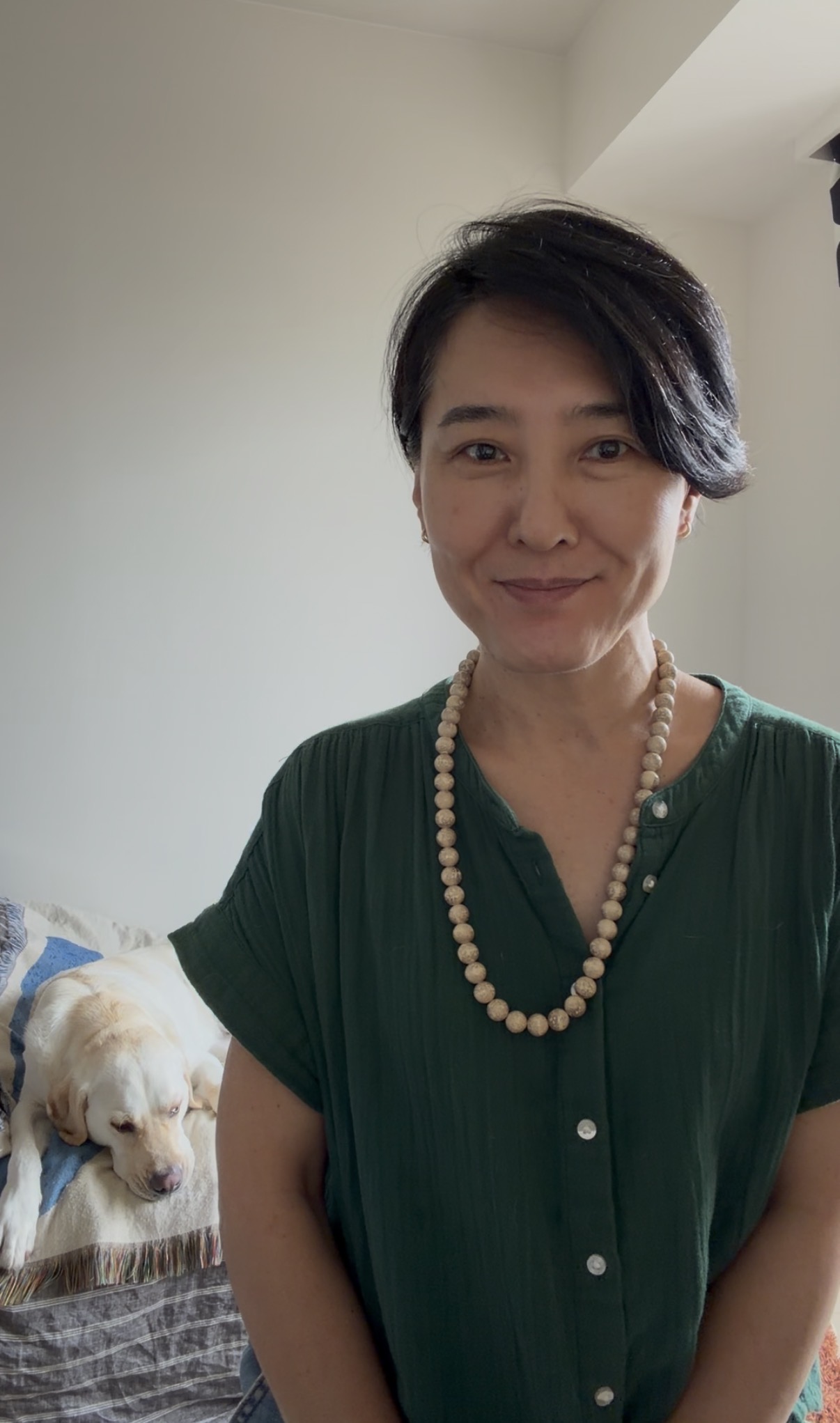
Aki Nakagawa
Aki Nakagawa
Graduated from Okayama Asahi High School and Okayama University, Faculty of Letters, Department of Language and Culture (majoring in English and American Literature). She taught Japanese, Social Studies, and English for elementary and junior high school students at Nokai Center (now WAO Corporation) Okayama branch and other locations. As a private tutor, she has taught Japanese for prefectural high school entrance exams, the Common Test for University Admissions (formerly Center Test) Japanese (including classical literature), English, and essay writing.
From 2009 to 2012, she studied Russian in Moscow. After returning to Japan, she served as a Japanese language instruction support staff for native Russian-speaking children at kindergartens, elementary, and junior high schools in Tokyo, dispatched by the Tokyo Metropolitan Board of Education. At the same time, she started offering Japanese lessons online through Russian media.
In 2014, she became a cooking instructor for the a.k.i.kitchen project. She has traveled regularly to Moscow, St. Petersburg, Chelyabinsk, Vladivostok, Sakhalin, and other locations for cultural exchange programs, media appearances, and magazine interviews, fostering international cultural exchange.
Currently, she offers flexible online lessons, adjusting for time differences with students not only in Japan but also in Russia, Ukraine, Estonia, Uzbekistan, Singapore, Dubai, USA, Portugal, Spain, Israel, and other regions across the globe.
Why Learn Japanese?
Unlike many European languages where almost all information can be understood by hearing, Japanese, which conveys various nuances using Kanji and Kana, is a visual language. For native speakers of European languages, this barrier is psychologically significant, and there are many cases where they live in Japan without using Japanese due to a sense of reluctance towards Kanji.
While it is possible to work and live in English without using Japanese, there are still reasons why we recommend learning the language. In fact, customs and sensibilities that Japanese people themselves take for granted are reflected in various ways in daily life and society, and they appear distinctive from a foreigner's perspective. These characteristics are also reflected in the Japanese language itself.
Features of Japanese, such as placing the most important information (verbs, negatives, etc.) at the end of a sentence or omitting the subject, actually hide what Japanese people value. By learning Japanese, you logically get to know Japanese society, and many students begin to develop a positive interest in Japanese customs that they previously found uncomfortable.
I provide guidance so that students can use Japanese that avoids mutual misunderstandings in communication with Japanese people, rather than just textbook expressions.
Furthermore, for families with children, if there are troubles at school, parents cannot focus on their work with peace of mind. Based on my experience providing on-site support at public elementary and junior high schools, I offer Japanese language instruction and daily life consultations for children to help them integrate smoothly. Drawing on my experience with Japanese cooking classes in Russia and interpreting/attending in the food sector, I also hold Japanese cooking classes for wives. I visit the homes of native Russian-speaking families to provide Japanese cooking instruction, cooking assistance, and shopping accompaniment (conducted in Russian).